
 It’s the very nature of the beast that casinos come and go in Las Vegas – it’s an ultra-competitive market, with some of the most famous names in gaming enjoying continued success and those without such prestige struggling to make inroads.
In the early 1970s, Caesars Palace was the main tourist hotspot on the strip, while Circus Circus was succeeding in attracting a new audience to Sin City thanks to its family-friendly atmosphere.
The Golden Nugget was another casino popular with gamblers seeking a no-frills experience, while Binion’s Horseshoe was attracting poker players to a destination more commonly known for the clanking of slot machines and the whirl of the roulette wheel.
So Frank Caroll, the building developer who wanted a slice of the burgeoning casino market, had his work cut out in establishing a footprint on the strip. He was the brains behind the Landmark Hotel and Casino – later used for filming many scenes of Martin Scorcese’s 1995 epic ‘Casino’, but had struggled to convince financiers to bankroll the project and ran out of money halfway through construction.
After four years, Caroll managed to finally scrabble the funding together to complete the construction project, but he was forced to sell the Landmark almost immediately to eccentric billionaire and Vegas resident Howard Hughes in order to make ends meet.
Undeterred, Caroll decided he was going to dip his toes into the water again, and after securing planning permission on a plum piece of land on Convention Center Drive, he revealed plans to build a new resort that would reimagine the gambling scene altogether.
In the end, the DeVille Casino ended up being one of the most costly and bizarre projects never to see the light of day in the neon city….
A Bright Idea
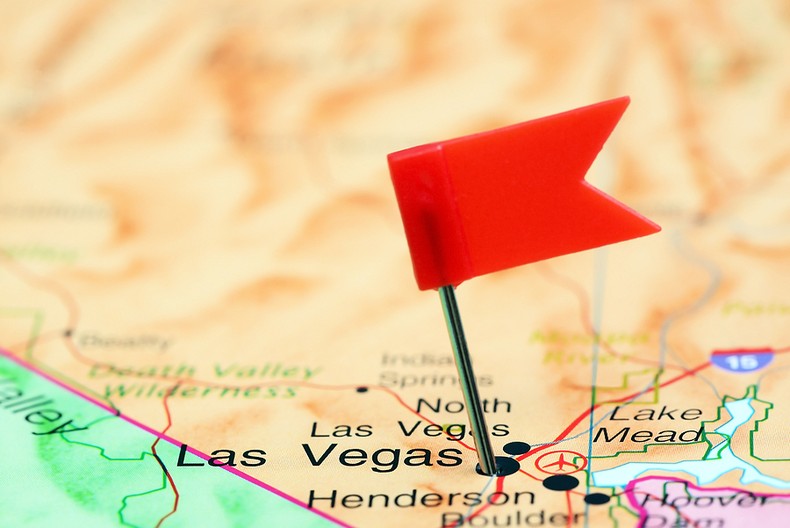
With a prime location secured just over the way from the infamous Landmark Tower and Hilton Vegas, Caroll must have thought success was guaranteed for his project.
He and his team of builders and contractors set to work during the late 1960s boom, and it wasn’t long before the foundations were dug and the building constructed. The DeVille Casino was ready to open in 1970.
To give you an idea of how close the establishment was to opening, Caroll had commissioned the design of the chips that would be used on the gaming floor – fast forward 50 years and these are now collectors’ items, although their value (around $11.99, or £10) won’t have you retiring to a yacht in Monte Carlo any time soon.
But, unbeknown to Caroll and his gang of investors, those chips would never be used for the intention they were designed for….
Unlicensed to Thrill

As can often be the case in these situations, the ultimate elephant in the room that prevented the DeVille from opening was an administrative error.
Caroll had simply delayed applying for a gaming licence from the Nevada state authorities, and so the construction of the casino was completed before it was even approved for opening.
And you can probably guess what happened next….
State regulators refused to hand Caroll a gaming licence, and so he was left with a fully built, equipped and staffed casino that could not open its doors to the public. It remained unused for a number of years thereafter.
It was an extraordinary oversight, and confirms the DeVille Casino’s status as one of the strangest ‘unicorns’ in Las Vegas’ development as the Western world’s premier gambling destination.
What Happened to the DeVille Casino?

Despite the fact that the DeVille Casino was constructed, decorated, furnished and even had a team of cashiers and croupiers employed, nobody showed any interest in buying out Caroll.
And why would they? Nevada state commissioners had shown a complete unwillingness to licence the establishment, and so therefore it held absolutely zero value as a going concern.
Unsurprisingly, it would lay dormant for the best part of two decades, before the plucky bosses of the Sport of Kings Racing Parlor decided to chance their arm on a building which had become infamous in Sin City.
The bookmaking operation would open the doors of the DeVille, finally, in 1992, but they too were struck down by bad luck – once again, state regulators refused to reissue their licence after just one year, with rumours abounding that Sport of Kings lost more than $1 million in their first month of business. That came after they posted odds of 30/1 on a horse that would eventually go off at 4/1….and win.
By 1994, the DeVille wasn’t a gambling establishment at all – in fact, it became The Beach Nightclub, which for a while at least was considered one of the hottest non-casino nightspots in all of Vegas.
But all good things come to an end, and The Beach closed its doors for the final time in 2006. The building was latterly demolished, and remains an empty, vacant lot to this day.
A sad end for an establishment once tipped to be one of most sophisticated gambling venues on the strip….
Frank Caroll: Las Vegas’ Unluckiest Man?

You could perhaps attribute one disastrous building project to bad luck. But two? Maybe the problem lay a little closer to home.
You can’t fault Frank Caroll for his ambition, but his involvement in not one but two of Las Vegas’ greatest disasters cannot be written off as coincidence.
We’ve documented the shenanigans that ultimately prevented the DeVille Casino from ever seeing the light of day, but arguably Caroll’s biggest gaffe came when launching one of Sin City’s other notorious lame ducks.
He devised the blueprints for The Landmark, a sky-scraping hotel and casino modelled on the iconic Space Needle tower in Seattle. Caroll’s version stood 31 stories tall, and in the adjacent area he also constructed a shopping centre and apartment buildings in a bid to build his own leisure village.
Work began in 1961, but stopped a year later when Caroll had to rather embarrassingly admit he had run out of money with the project 80% complete.
He managed to secure a $6.5 million loan – a huge sum in those days – to complete the build, and things appeared to be running smoothly….until Caroll had another of his trademark gaffes.
The construction entrepreneur got into a fistfight with The Landmark’s interior designer, and would later be charged with assault and battery. On the grounds of his criminal conviction, Nevada state chiefs refused to grant Caroll a gaming licence. He was forced to sell the development to Howard Hughes at a reduced rate.
But the venue seemed cursed from the get-go. Hughes, who had enjoyed success with his other Vegas investments, could not turn a profit at The Landmark, and when he died it was sold to another consortium.
They, and subsequent buyer William Morris, both ended up filing for bankruptcy after ploughing funds – unfruitfully – into The Landmark, and there was so little interest in the building that the Las Vegas Convention and Visitors Authority ended up buying it for the sole purpose of tearing it down.
By 1995, The Landmark had been demolished to create extra parking for the nearby convention centre, and the implosion can be seen in Tim Burton’s 1996 opus ‘Mars Attacks’.
Given the success rate of his Las Vegas projects, Frank Caroll must have been on another planet when he dreamt them up….