
 Even the most casual of casino enthusiasts know that blackjack hands are typically played until their natural conclusion.
The player may have a natural blackjack, e.g. the perfect hand of 21, they might stand on a score of between 16 and 21 or they will bust after hitting one too many cards.
But what many don’t know is that some forms of blackjack offer another option after the deal: surrendering your cards.
So what is blackjack surrender, and is it ever a good idea to fold your cards in blackjack?
Blackjack Surrender Explained
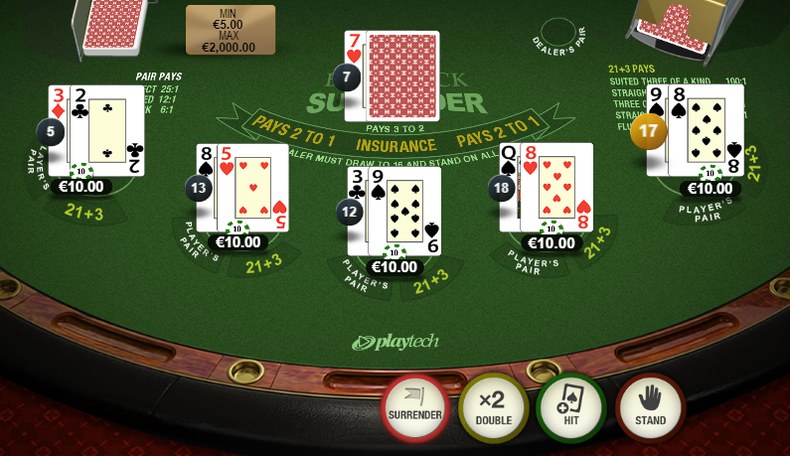
Available in many American casinos and some online games, the surrender rule in blackjack effectively lets you fold your cards and walk away from a hand.
It will cost you half your stake to surrender, and so there is a theory that if you get dealt a trash hand it’s actually more cost-effective to cut your losses rather than playing on and hoping to hit a slice of luck before standing on a competitive number.
There are two general types of blackjack surrender, and it’s worth knowing which rules your chosen game carries before hitting the felt. The first is ‘early’ surrender, which allows you to fold your hand and claw back half your original stake if the dealer shows an ace or ten-value card as their upturned card before any further betting action has taken place.
Many casinos refuse to allow early surrender because it eats into their profit margin considerably, and the introduction of the rule – thought to have taken place in the 1970s when Atlantic City casinos were desperate to attract players with more agreeable conditions – still remains something of a moot point.
By contrast, late surrender allows you to fold your cards AFTER the dealer has checked to see if they have a natural blackjack. If they do, you lose anyway so surrendering is not available. If they don’t, you can still choose to fold if you don’t like the make-up of your hand.
This is less damaging to a casino’s house edge, so therefore you are more likely to find the late surrender rule online and in your local casino. But even then, it does hand the player that knows what they’re doing an advantage – so it’s well worth being aware of when and when not to surrender your cards.
When Should You Surrender in Blackjack?
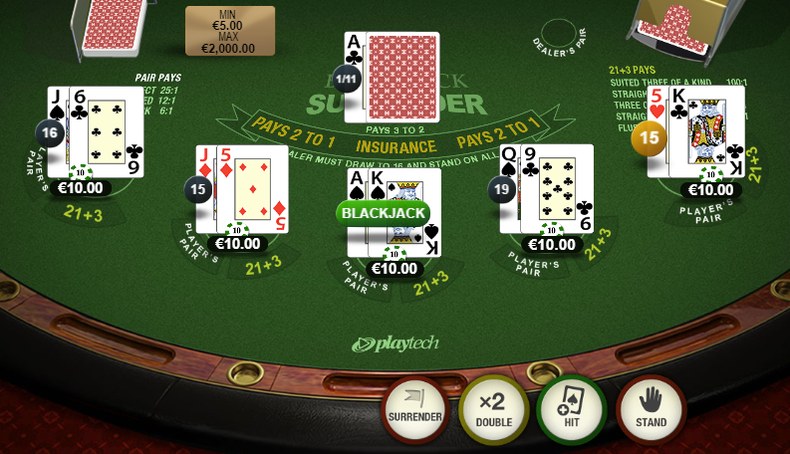 One of the interesting things about the early surrender rule is that it can save you money in the long run.
Although the probability of the dealer having a natural blackjack is low – in a single-deck game, it’s about 4.8% or roughly one in twenty hands.
But the dealer’s win probability increases significantly if they have an ace or ten-value card straight out of the deck, and so by taking the early surrender option you are able to protect your bankroll better – not always, but in the majority of cases.
In fact, the early surrender rule damages the house’s edge, which is probably why blackjack surrender games have other rules that hand the dealer an edge once more – perhaps they can hit on soft 17 rather than being forced to stand, for example.
There are clearly some scenarios when surrendering your cards when the dealer has an ace upturned is a no-brainer. If you have a low-value, hard hand worth five-seven then you really should surrender, as you would with a troublesome mid-range hard hand like 12-16. Your win probability is suitably low when tackling a dealer with an ace in their hand.
Even if the dealer is showing a ten-value card, you will still need to consider whether surrendering is the smart play. If you have a hard 14, 15 or 16, for instance, then there’s a strong chance you will bust when hitting – surrendering will claw back half your stake and eliminate that as a possibility.
In late surrender blackjack, you know that the dealer doesn’t have a natural 21 out of the gate, and so you should be more circumspect in surrendering your cards. In fact, you should play on as normal in most scenarios – again, the outlier is when you have a hand in the range of 14-16. Here, you have such low expected probability of winning that surrendering is the percentage play.
When Shouldn’t You Surrender in Blackjack?
With such specific criteria for when to surrender, it’s clear that this is a rule best avoided unless your hand – or the dealer’s upturned card – fall into the categories outlined above.
So, if the dealer’s upturned card is an ace, you shouldn’t surrender unless your hand is worth between five and seven or 12 and 16 and doesn’t feature an ace of your own. Otherwise, surrendering isn’t the percentage play in the long run – you’ll win enough hands to negate the alternative of scooping half your initial stake back.
If the dealer’s upturned card is a ten or picture card, you should carry on playing your hand as you normally would using the guidelines of basic strategy. That is, of course, unless you have a hard 14, 15 or 16, whereby your chances of hitting a competitive total are lower when considering the ratio of cards in the deck that can help you against those that don’t.
When you have been dealt a pair, the normal rules apply on whether to split, hit or stand – in this case, surrendering is unlikely to be the savvy option unless you have a pair of 7s or 8s, but even then the rules of splitting and doubling-down still apply.