
 As you are no doubt already aware, there are stacks of different versions of blackjack you can enjoy. While the rules and betting options of these can vary from one game to the next, for the most part one stipulation is universal: the dealer’s cards, in most cases, or at least one of them, remains a complete mystery until the betting rounds are completed.
That’s what makes Double Exposure Blackjack so interesting: here, both of the dealers cards are upturned from the get-go, so you can see exactly what they’re working with. It certainly adds a great deal of context to your betting decisions, and – in theory – you should win more hands as a result. So, is Double Exposure set to be your new favourite version of blackjack?
Double Exposure Blackjack Rules
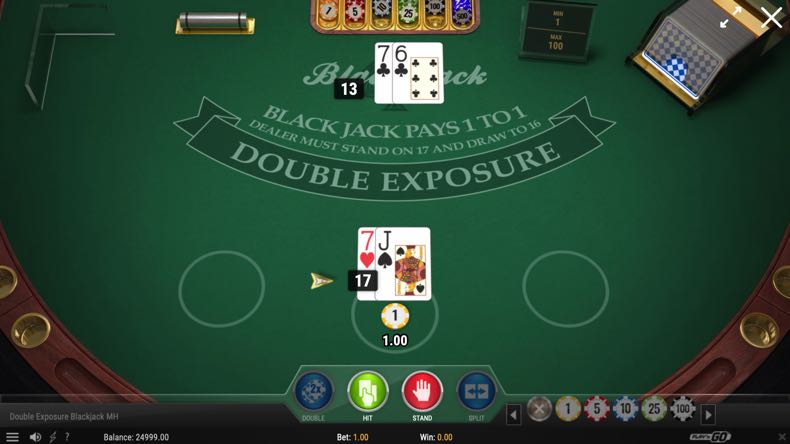
If each player can see the dealer’s cards, there has to be some redressing of the balance in order for the house to maintain their edge, right? Correct. In Double Exposure Blackjack, there’s two main differences to other forms of the game that change the dynamics of play somewhat:
- Natural blackjack is paid out at 1:1, rather than the standard 3:2
- Players lose when their hand ties with the dealer
These points of difference are considerable, and while natural blackjack hands are rare – therefore, a lower payout isn’t the end of the world, finding yourself in a losing position if you tie definitely changes how the game is played. There is one exception to the latter rule: you’ll get your stake pushed back if you and the dealer both have a natural blackjack.
There’s a couple of other caveats too, although these are less of a consideration for the most part. You cannot surrender your hand in Double Exposure Blackjack, and by the very nature of the dealer revealing their cards you cannot buy insurance against them having a natural 21 either. Some versions of Double Exposure also place certain restrictions on splitting and doubling down, however, these are the exception to the rule – both of those strategies are typically allowed in this unique form of the game.
The house edge of Double Exposure Blackjack is around 0.66%. Even though you can see the dealer’s cards, you are still worse off – theoretically speaking – than when playing games like American Blackjack or Blackjack Surrender, where the house’s edge is around 0.35% and 0.38%, respectively. These seemingly minor details can make a difference in the long run.
How to Play Double Exposure Blackjack
The basic mechanics of playing Double Exposure Blackjack are the same as any other version of the game. You’ll place a bet of your choosing and then receive your two cards, while also being able to see the dealer’s cards face up on the felt.
Your betting options are the same as normal: you can stand, hit, double down or split when your two cards have the same value. Interestingly, when you split aces in Double Exposure Blackjack you’ll only be allowed one more card for each split hand – making it more impossible to land a five-card trick via a pair of aces.
The action plays out as it does for any other version of blackjack: the closest score to 21 without busting wins, albeit in Double Exposure if your hand is tied with the dealer’s you lose, rather than having your stake returned.
Double Exposure Blackjack Strategies
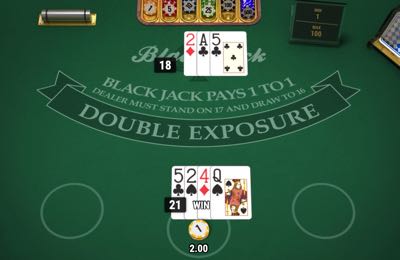 Now that you can see both of the dealer’s cards before you make any betting decision, clearly your tactics will differ from accepted blackjack standards. For example, you will find yourself hitting in the most bizarre circumstances: if you have 19 and the dealer has 20, you will have to take another card despite the low probability of landing what you need – you’d have around a 15% chance of landing an ace or a two, all things being equal.
Having a clearer idea of what you need to do to beat the dealer throws blackjack conventions out of the window. If the dealer has a weak hand, you may find yourself doubling down on 12 or 13 (if the rules allow for it). Conversely, you’ll be hitting on 16 and even higher if they have a strong hand, while decisions on when to split will be determined by what the dealer has in their hand – holding on to a pair of tens or face cards can be wise.
In other ways, the rules of engagement are the same. Because the player has to act first, you still want to be standing in that 17-20 sweet spot – assuming the dealer has 16 or less. Remember that the dealer has to stand on 17, so that should influence your betting decision.
Basic Bonanza
Applying basic strategy is key to maximising your chance of success in any form of blackjack. But in Double Exposure, so much of the guesswork is removed – therefore, following the right principles, as outlined by basic strategy, become even more vital.
Our tip? Have the basic strategy playing guide at your side when you load up Double Exposure Blackjack. This will ensure you make the percentage plays every single time – if your luck is in, you may well get a net win and have plenty of fun throughout the game.