
 By day, F. Doyne Farmer is a scientist and university lecturer that specialises in chaos theory and econo-physics.
By night, in the late 1970s at least, he was the man that took down a number of casinos with an ingenious ruse.
And all it took was a tiny computer hidden inside a shoe….
Although he hasn’t achieved mega fame around the world, perhaps J. Doyne Farmer should be recognised as one of the leading technologists on the planet.
After all, it was he – as part of a group of physics graduates called Eudaemonic Enterprises – that designed and built the world’s first ever ‘wearable’ computer, some five decades ago no less.
As Farmer recalls on his own website, that was roughly the same time that Apple revealed their first desktop computer, so Eudaemonic Enterprises were years ahead of some of the sharpest technological minds around.
The problem, perhaps, was that Farmer didn’t create the portable computer for wider, public use – instead, he and childhood friend Norman Packard had a very specific goal in mind for their game-changing device….
They were going to use it to beat the roulette wheel.
Timing is Everything

In fairness to Farmer, he did have good intentions for any winnings generated at the casino: he wanted to build a ‘science commune’, where the best minds in the field could convene to further their knowledge and create innovations that could benefit mankind.
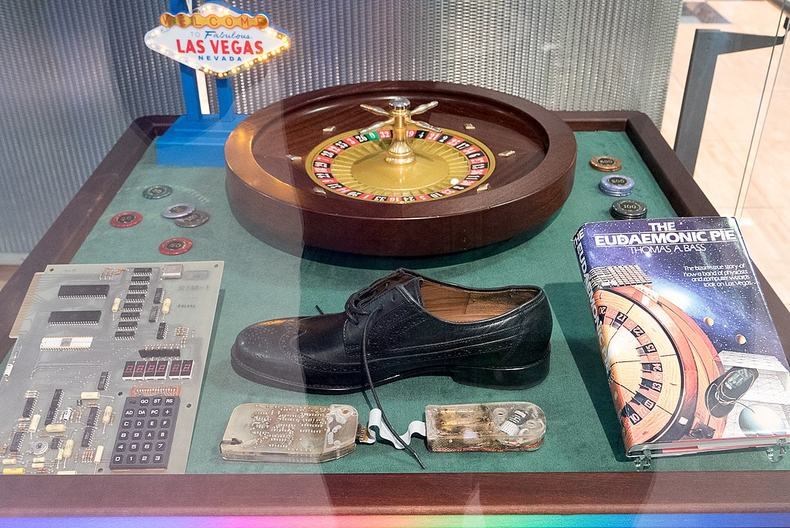
The device he designed and coded was a chip that was built into what looked like the standard insole of a shoe. But that was only part of the ploy’s brilliance: the shoe-wearer would click a switch with their big toe at the moment that the croupier released the ball into the roulette wheel – the operating software would then calculate the velocity and position of the ball once the wheel had come to a standstill, which was confirmed by a second toe tap.
Meanwhile, the data was transmitted to an accomplice – which was usually Farmer’s friend Thomas Bass – who would be stood next to the roulette betting table. He would seed bets into the game based upon the information received from Farmer.
There’s typically a ten-second span in which the ball starts bounding around the wheel and the croupier stops taking bets, and it was during this window that the intrepid players looked to take full advantage.
It was a delicate system but one that appeared fool-proof – in theory, at least. They acquired their own roulette wheel and tested out their technology thousands of times, and were satisfied with the results, which suggested they had a greatly increased chance of predicting the number, or at least its near neighbours on the wheel, in which the ball would land. They could bet on single numbers and groups accordingly.
So that was the theory. But did Farmer’s shoe computer actually work in reality?
Hard Yards

Farmer and his team, sensing they were on to something, created an itinerary that would seem them travel to casinos across America in a bid to avoid detection.
That included trips to Reno, Tahoe and, of course, Las Vegas, and no matter what state they were in the results were unanimous: Farmer’s machine not only eliminated the house’s edge, it even handed the shoe-wearer and their accomplice an advantage in win expectancy of around 20%.
The gang were, however, keen to avoid detection, so rather than betting big and perhaps giving the game away, they continued to deploy small stakes – a move that they would perhaps later regret, even if they enjoyed a few years of consistent profits.
That’s the good news….
The bad news is that the plan rarely went without a hitch, as Farmer’s super-computer would suffer from regular hardware malfunctions.
The main problem was that the receiver in Bass’ shoe would begin to twitch almost at random, which prevented clear communication between he and Farmer. They later realised that the myriad electronic devices within the casino were disrupting their signal, and they would therefore need to completely overhaul their system of communications.
Dismayed at the prospect of going back to the drawing board, and becoming increasingly paranoid about what would happen if their scheme was found out – casino security of the early 1980s tended to deploy a ‘liberal’ approach to warding off advantage players, as later depicted in the Hollywood movie Casino.
So the plot to defeat the roulette wheel was a success, even if Farmer later admitted that it ‘failed to realize’ the profit potential that he and Packard had initially hoped for. Depending on whose story you believe, it’s thought that the scheme profited to the tune of around $10,000 – or around £30,000, accounting for today’s inflation and exchange rate.
Predict and Repeat

Later, Farmer used his skills and insight to tackle the stock market, creating one of the first programs to take advantage of statistical arbitrage. His firm, simply called the Prediction Company, was sold to Swiss banking outfit UBS in 2005 for an undisclosed sum.
And should you ever find yourself in the German city of Paderborn, you can see Farmer’s shoe computer in all its glory at the Heinz Nixdorf Museum.
New research from Michael Small and Chi Kong Tse confirms what Farmer suspected all those years ago: if you can accurately model the velocity of the ball as it passes around the roulette wheel, you can predict with a relative degree of certainty where it will land from any starting point – removing the house’s edge and creating an expected return in the region of 18%.
If nothing else, Farmer and his colleagues are proof that the house doesn’t always have to win – if you are adept at creating technology years ahead of its time, that is.