
 Imagine watching a lottery draw on TV at home and sitting, standing or dancing in jubilation as your numbers are called out one by one.
That would have been the case in the Philippines in October for anybody that picked 9, 18, 27, 36, 45 and 54 on their ticket for the Grand Lotto draw, which promised a jackpot of 236 million pesos – around £3.5 million.
Imagine winning that kind of sum? What would you spend it on first?
Unfortunately for winners of the Grand Lotto, the plot would thicken. It turns out that there were 433 winning tickets – a record number for any one single draw.
And so somebody who thought they had won £3.5 million would instead have taken home the rather more modest sum of £8,083.
The country’s senate minority leader, Koko Pimentel, has called for an inquiry into an outcome that he has described as suspicious.
But is there a more straightforward reason for this most incredible of lottery results?
Nine Is Fine

Take another look at the winning numbers from the fateful Grand Lotto draw: 9, 18, 27, 36, 45, 54.
Do you notice anything unusual about them? There’s a gold star on its way in the post if you noticed that the numbers were a specific pattern – the first gambits of the nine times table.
It’s not uncommon for lottery players to buy tickets with such sequences of numbers on them – often sevens, given that number’s typically lucky image around the world, or even patters like 1, 2, 3, 4, 5 and 6. After all, these sets of digits have just as much a chance as any other to be drawn from the machine.
It’s also not unusual for lottery fanatics to stick with the same numbers week after week – hence why so many lucked out when the ‘notorious nines’ had their day in the sun in the Philippines.
Terence Tao, a maths professor at the University of California, admitted it’s ‘not surprising’ when so many players win in a week where an identifiable pattern of numbers is drawn.
“There are hundreds of lotteries every day around the world, and statistically it would not be surprising that every few decades, one of these lotteries would exhibit an unusual pattern,” he said.
“It’s similar to how in any given hand of poker it would be unlikely to draw a straight flush, but if one looks at hundreds of thousands of hands at once then it actually becomes quite likely that a straight flush would be drawn.”
A spokesperson for the Philippine Charity Sweepstakes Office (PCSO) has revealed that nine is a particularly popular number to pivot from for players in the Grand Lotto, and it is considered a lucky number in many different cultures – apart from in Japan, where phonetically nine sounds like the translation for ‘torture’.
The PCSO also confirmed that there was no way that the Grand Lotto draw could be rigged, given that it is broadcast live and there are independent auditors on the scene to scrutinise every move.
The Power of the Pattern
There’s many reasons why lottery players use common sequences and patterns in their numbers.
One is that they perceive it to be lucky, e.g. multiples of a lucky number like seven, or picking 7, 17, 27, 37 etc.
Others pick the same numbers because they fear that if they change their digits, it’s almost sod’s law that their previous set will be drawn and they will miss out on a monumental payday.
Some players pick their numbers based upon a pattern on the selection ticket, e.g. they will draw from a vertical, horizontal or diagonal set of digits.
What’s interesting is that any combination of numbers, whether you pick a random pattern or a specific set of six, has the same odds of being drawn – for 49-ball lottery games with six numbers to be called, your chance of winning the lottery is around 14 million to one.
Ironically, you could increase your chances of winning in one way – The Guardian, albeit back in 2014, discovered that the number 23 had been drawn in the UK lottery 266 times (the most common), whereas 20 had only been drawn 204 times. However, this is variance in action – that is, it’s highly unlikely that all numbers would have been drawn the exact same number of times in a relatively small sample size.
So, ultimately, it doesn’t matter which six numbers you choose, although – as they found out to their cost in the Philippines and the other examples shared below – staying away from ‘obvious’ patterns is the smart play as you will almost certainly take home a bigger cheque from your win.
It’s as Easy as 1-2-3….4-5-6
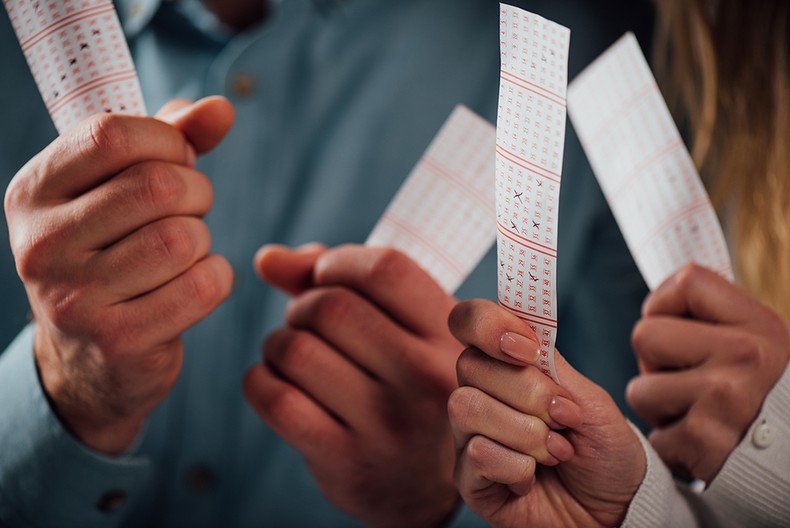
Here’s a fun stat: according to UK National Lottery chiefs, around 10,000 players typically pick the numbers 1, 2, 3, 4, 5 and 6 every week.
Memorable? Sure. But if you won a £5 million lottery draw, you’d end up taking home £500. A nice sum, but imagine the emotional turmoil you would feel at not trousering a bigger slice as a lottery winner?
The most popular sequence of numbers picked is the multiples of seven – 7, 14, 21, 28, 35 and 42, so if you want to win a huge jackpot maybe don’t pick those. Funnily enough, that combination still hasn’t been drawn in nearly 30 years of UK lottery action.
However, a variation of it has. In March 2016, amongst the six winning numbers of the smaller-scale Lotto draw were 7, 14, 21, 35 and 42….with only 28 missing from the multiples of seven set. Even so, 4,082 players – described as ‘unprecedented’ by then lottery operator Camelot – still picked the winning combo, and a £61,000 jackpot was shrunk to just £15 each.
For the main lottery draw in the UK, the most winning tickets for a single jackpot was 133. Back in January 1995, the mammoth £16.2 million kitty was sliced up to hand each winning player £122,510. Why? Because they had all picked 7, 17, 23, 32, 38 and 42, which are the digits that go run down the central column of the number-picking ticket.
You wonder if the winners of significantly-reduced payouts even consider their triumph worth it? Imagine being the Spanish TV reporter who, having won the El Gordo lottery in December 2019 whilst live on air, began dancing in jubilation and even quit her job while broadcasting to millions of people.
Aquí la tienes: “la reportera de La 1” de la que habla todo el mundo a estas horas. ¡Se llama Natalia Escudero! #LoteríaRTVE
🔴 Directo ➡ https://t.co/pfgTOQpaaN pic.twitter.com/58j3ACuNte
— RTVE Play (@rtveplay) December 22, 2019
The problem for Natalia Escudero is that she hadn’t scooped the full €4 million jackpot because her lucky number, 26590, was shared by hundreds of other players. Instead, she took home €5,000….and presumably had to embarrassingly grovel for her job back.
People’s inability to understand randomness and variance even saw one South African PowerBall lottery draw probed by watchdogs after 5, 6, 7, 8, 9 and 10 were drawn back in December 2020.
Unable to comprehend how that might be so, a full investigation was launched by lottery chiefs into how 20 winning tickets had picked such a sequence. That probe ultimately concluded that such patterns are commonly picked by players.
And what about when the same sequence of winning numbers comes up not once but twice? That does sound a bit fishy, but it happened in Bulgaria back in 2009 when 4, 15, 23, 24, , 35 and 42 were drawn in consecutive games in September.
Whether by coincidence or something more sinister, nobody won the first time it happened….and yet 18 players picked the same numbers just four days later.