
 Today, Las Vegas is known as a bustling, neon tourist trap that guarantees its visitors a good time….although the ‘Sin City’ nickname acts as a constant reminder of the nefarious foundations upon which the city is built.
Indeed, without a Jewish mobster linked to the ‘guns for hire’ Murder, Inc, and a Texan cowboy with a flexible attitude to what constituted right and wrong, we might never have had the casino resorts and the tournament-style poker games that we know today.
And then there was Howard Hughes, the partially deaf, OCD sufferer who also happened to be a billionaire film producer and aviation expert, who once broke the world air speed record with a flying boat he had personally designed. Without Hughes, Las Vegas may have remained a Mafia money laundering scheme, and not the haunt of casino gamers, travellers and good-time seekers that we know to this day.
The genesis of modern gambling can be traced back to three rather eccentric individuals whose life stories make for rather compelling reading….
Bugsy Siegel: Breaking Bones and Treading New Ground
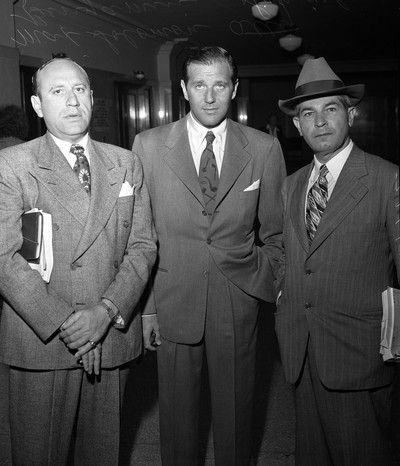

In 1946, Bugsy Siegel opened the Flamingo, the first truly integrated casino resort on the Las Vegas strip that featured games like blackjack and roulette alongside fine dining and swanky hotel suites. It remains open to this day under the Caesars umbrella, and the drinks are still free for those seated at the gaming tables.
In 1947, Siegel was shot dead by a sniper – his past catching up with him. But not before he had effectively created the Las Vegas still enjoyed by millions decades later.
By all accounts, Benjamin Siegel – the second child of a poor family of Jewish immigrants from Austria and Hungary – was not a nice man.
He was a thief and ran protection rackets in his younger days, before a chance meeting with Meyer Lansky saw Siegel transition into illegal gambling and bootlegging – the importation of alcohol to circumnavigate the rules of prohibition in the 1920s.
Siegel and Lansky created the Bugs and Meyer Mob, one of the most feared stables of gangsters and mobsters of the age, with Siegel also freelancing as a contract killer. The gang would be the precursor to Murder, Inc, the infamous band of assassins thought to be responsible for between 400 and 1,000 slayings in New York City and other locations.
Becoming increasingly wealthy, Siegel began to mix amongst the Hollywood elite following a move to California, and when he wasn’t trying to sell explosives to world leaders such as Mussolini, he was eyeing an unlikely move into legitimate business – the burgeoning entertainment scene in Nevada, close to the site of the Hoover Dam construction project.
Siegel effectively bullied William R. Wilkerson into selling the Flamingo to him, which at the time was mainly a hotel. But not for long, as the mobster introduced gambling, dining and hospitality to the establishment, and the sprawling resort became the blueprint for all that would follow on the Las Vegas strip.
But just months after turning the Flamingo into a legitimately successful business, Siegel was assassinated as he drank his morning coffee at home in Beverley Hills. The perpetrator was never caught, and the case remains unsolved 75 years later….although rumours suggest that Lansky may have ordered the shooting as revenge for Siegel’s lavish overspending on the casino.
Although evidently not a nice man, anyone that has played at a Las Vegas casino perhaps owes Siegel a debt of gratitude for his foresight and vision of what the strip could become.
Benny Binion: Poker’s ‘Baddest Good Guy’

While Siegel and his chums were raising hell in Hollywood and New York, Benny Binion was building an illegal gambling empire of his own in Texas.
The son of a horse trader, Binion soon got wrapped up in illegal gambling games and bootlegging, and he earned his ‘cowboy’ nickname when killing a rival rum-runner, Frank Bolding. He escaped from another murder without punishment by shooting himself in the shoulder, claiming he was fired at first by his victim, Ben Frieden.
But it was the world of gambling that most interested Binion, and he set up his Southland Syndicate to run private dice games in a number of hotels across Texas. By the 1940s, he was the ruling mob boss in the Lonestar State, thanks to an extensive squad of muscle and the assistance of deferential local politicians.
It was only when a new sheriff for Dallas County was elected that Binion lost his edge, and so he packed his bags and set off for the burgeoning gambling capital of the world, Las Vegas.
After short runs as an owner or investor in the Las Vegas Club casino and the Westerner Gambling House and Saloon, Binion acquired the casino that he would be best known for: the Eldorado, which he would rename Binion’s Horseshoe.
Binion himself was soon considered an innovator of the Las Vegas strip, raising stake limits, using limousines and other VIP perks to attract high rollers and offering free drinks to all players.
But it was his foray into poker hosting that ultimately led to the invention of competitive poker, which would culminate in the popularity of the WSOP and other brands.
Binion agreed to host a heads-up game between Johnny Moss and Nick ‘The Greek’ Dandalos, two of the pre-eminent card players of the time. It was a game that would last five months in total, with Moss taking Dandalos for a reported $2 million.
Insane hand between Johnny Moss and Nick the Greek in 1949 playing 5 card stud:
Moss brings it in for $200 with (9) 6
Nick makes it 1500 showing a 7. Moss calls
Moss catches a 9, Nick a 6. Moss bets $5k, Nick makes it $25k…
— Daniel Negreanu (@RealKidPoker) January 7, 2020
Binion would spend years inviting top card players to take each other on at his establishments, before in 1970 he hit upon the brainwave of hosting a six-player poker tournament. The championship style format was considered a huge success, and in essence the World Series of Poker was born.
Although he considered himself to be a pretty average player himself, Binion was inducted into the Poker Hall of Fame in 1990 for his role in creating the blueprint for tournament poker that is still enjoyed to this day.
Howard Hughes: Aviation Pioneer Turned Vegas Tourism Titan

Although Las Vegas enjoyed great popularity in the 1940s and for the next few decades, it was still considered to be a mob-run city that struggled to attract a more cosmopolitan audience.
However, that changed in 1966 when Howard Hughes, movie producer, aviation expert and business mogul, arrived at the Desert Inn, the fifth resort opened on the Las Vegas Strip.
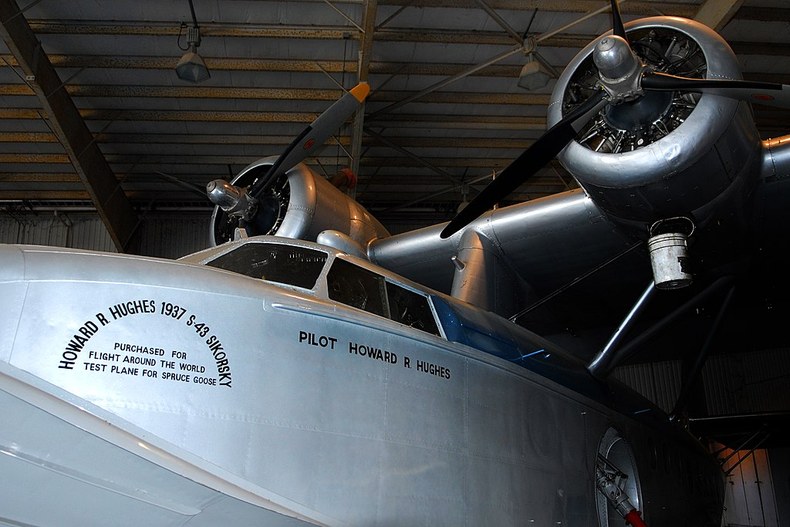
Hughes had made billions from producing films including the original Scarface and Hell’s Angels, before setting up his Hughes Aircraft Company, whose many successes including building the world’s biggest flying boat and breaking the air speed record on numerous occasions via the Hughes H-1 Racer and H-4 Hercules.
Blessed with riches, Hughes was so enamoured with the Desert Inn that he bought it outright, before moving into the ninth-floor penthouse as his permanent residence.
Hughes also went on to buy other casinos, including the New Frontier, Sands and Landmark Hotel and Casino, and even reportedly acquired the Silver Slipper just so he could move its neon sign, which blocked his view of the city from his window.
He had ambitions of turning Las Vegas into a city loved by people all over the world, and set about introducing a friendlier, more respectable ambience to contrast the seedy, murkier reputation that Sin City had since its Mafioso involvement.
A veritable recluse, Hughes allegedly spent his entire time holed up in his Desert Inn suite, with the curtains pulled. After a plane crash broke nearly every bone in his body, Hughes had become addicted to morphine, and he also developed OCD about germs – refusing to let anybody clean his apartment. Some hotel staff claim he spent his entire time naked, his 100 lb form a complete contrast to his 6ft 4in height.
So reclusive was the billionaire that he refused to apply for his gaming licence in person, with Nevada governor Paul Laxalt appearing on his behalf and pleading with the regulators to allow him to buy up much of the strip.
They agreed, and it’s thought Hughes spent more than $60 million on casino purchases and renovation work in little over a year.
Without his intervention, Las Vegas may have remained a hangout for mobsters and their celebrity pals. Hughes, despite his personal demons, made it cool for everyone to head for the Neon City.