
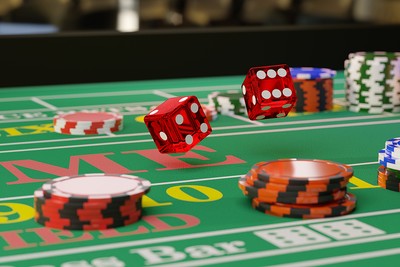
 When you frequent a casino, be it in person or online, you can’t help but be impressed by the sheer number of games that are available to play.
For the most part, many casino enthusiasts are aware of the basic rules of the likes of blackjack, roulette and poker – even if the specific requirements of the numerous variants need to be brushed up on before taking a seat at the table.
But there are other popular casino games that many players don’t know how to play – despite these titles being ubiquitous in casinos all over the world.
One of those is Craps, the dice game that is enjoyed from Vegas to Macau (and hundreds of casinos online). But what is it? How do you play it? And what the heck does ‘snake eyes’ actually mean?
If you’ve never played Craps before, you may just be missing out on what could be your next favourite casino game.
History of Craps
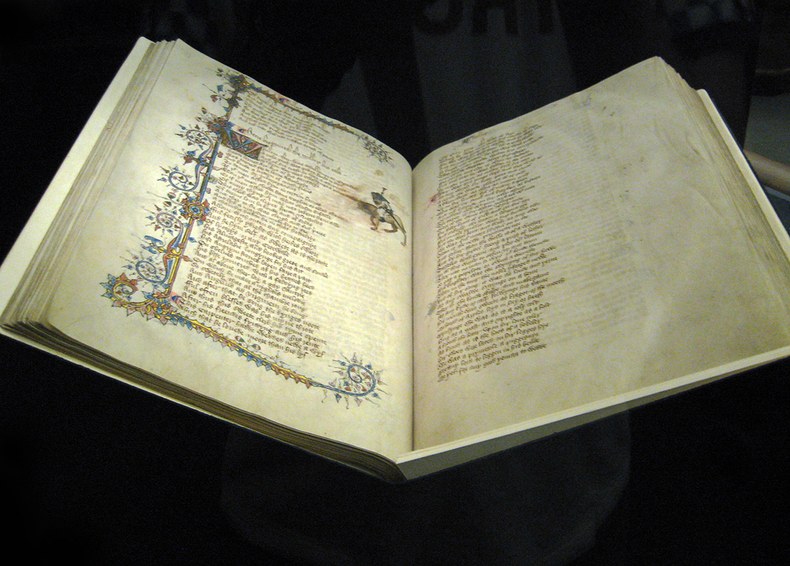

Have you ever read the Canterbury Tales by Chaucer?
Don’t worry if you haven’t, but it’s interesting that the origins of Craps can be traced back to a book published 700 years ago.
Canterbury Tales featured a dice game called Hazard, which had rules so complicated they are almost impossible to put into words (you’d need a full-length novel just to explain what happens when each number is rolled).
Hazard was introduced to casinos in the UK in the 18th Century, but its complexity was such that it wasn’t long before an offshoot – Craps – was born that would overtake Hazard in popularity very quickly, especially in North America.
Why is it Called Craps?
You’re right; it’s a pretty odd name for a dice game.
When Craps first made its way over to North America it was actually called Crabs – the casual term for when a two and a three were rolled.
But somehow, Crabs became lost in translation and was instead named Craps – possibly, it’s thought, due to the thickness of the Louisianan accent, where the game first grew in popularity in the United States.
Craps was a game that enjoyed a boom in popularity during the Second World War, with soldiers rolling the dice during downtime between assignments. As the service-men returned to Las Vegas and sought work on the Hoover Dam project, Craps found its way into the early casinos and gambling dens of Las Vegas.
Soon, Craps was a regular fixture in casinos in Sin City as well as Europe, Asia and Australia, and the simplicity of the gameplay meant that Craps easily made the transition to online casino action during the early 2000s.
How to Play Craps
Although there’s different elements to remember, in Craps you are quite simply betting on the outcome of a roll of two dice.
The action gets underway with a ‘come out’ roll, where you (you may be referred to as the ‘shooter’ in this position) will roll the two die to establish the round of betting.
There are three possible outcomes to the come out roll:
- Natural – this is a combined score of 7 or 11. This is an instant win for the player.
- Craps – sometimes known as ‘crapping out’, Craps is a combined score of 2, 3 or 12. This is an instant loss.
- Point – if you roll any other number, this is known as the Point.
When you roll a Point score, you then roll the dice for a second time. If you score the same number – it doesn’t have to the same combination of dice as before – before you roll a seven you win. If you roll a seven before your point number, you lose.
These are the fundamental rules of Craps, although there’s plenty more nuance to the game courtesy of the many different bets that you can place.
What are the Different Bets in Craps?
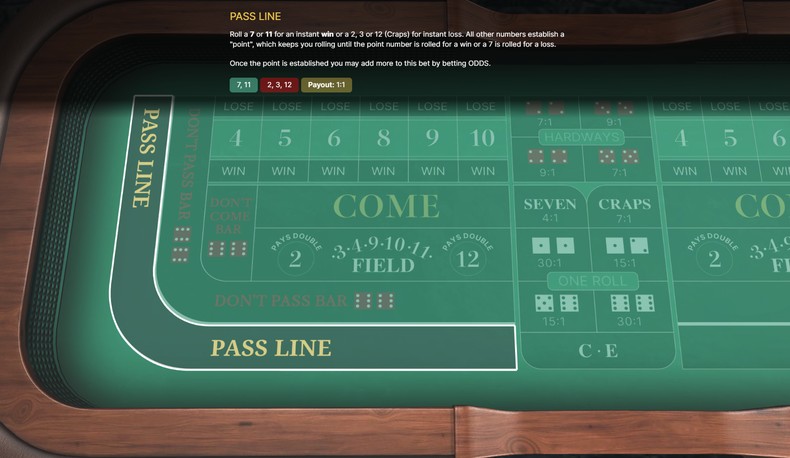
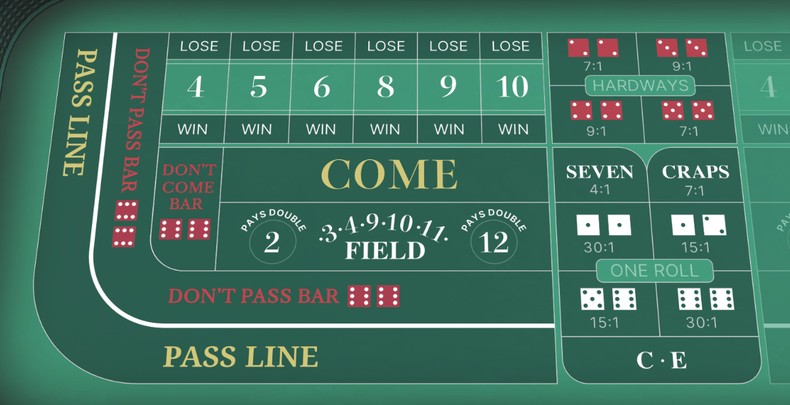
When you play Craps at the casino or online, you will notice that the gameboard has a stack of different betting options available.
The most common bet type is Pass or Don’t Pass. The Pass bet is placed on the player (shooter) winning, either via a natural or by successfully rolling their point number. Don’t Pass bets are wagered on the player losing; be it from crapping out or hitting a seven before their point number.
The Pass or Don’t Pass bets are placed before the dice have been rolled, but once the point number has been established where necessary a new betting heat opens up. The Come bet wins if the players rolls their point number before a seven, while conversely the Don’t Come bet prevails if the player rolls a seven before their point number.
It’s worth noting here that in some versions of Craps, a 12 will void Don’t Pass and Don’t Come bets – your stake will be refunded.
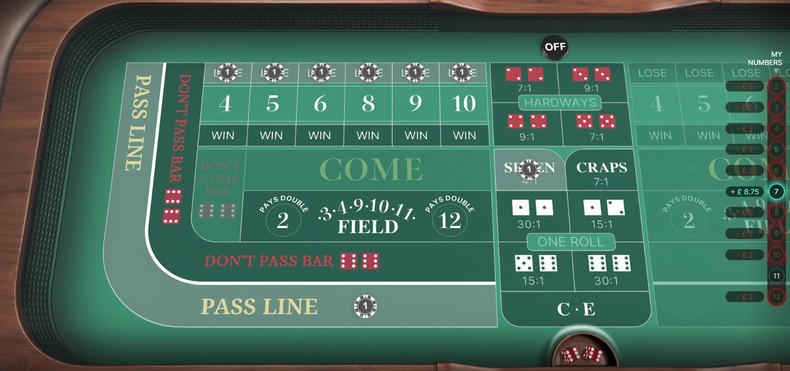
The Craps table features a number of other betting options. You can wager on any seven or Craps being rolled (i.e. it doesn’t matter which combination of die scores it), or on any individual number – these are displayed visually on-screen, while some combos have specific names, e.g. Ace-Deuce is a score of three made up of a one and a two, while Boxcars is 12 (a pair of sixes).
Some Craps versions let you bet after the point has been established in other ways. The Place bet allows you to wager on any single number being rolled before a seven, the Field bet wins if the ‘outside’ number is rolled (2, 3, 4, 9, 10, 11, 12) before an inside (5, 6, 7, 8), while the Big 6 and Big 8 bets are exactly as they sound – these pay out if a score of either six or eight is rolled before seven.
What are the Best Bets in Craps?
Like all casino games, Craps has a house edge – the casino wants to limit their liability as much as they possibly can.
And that explains why there are no positive expectancy bets to be made at the Craps table – although there are ways you can give yourself the best possible chance of winning a round.
The house edge on Don’t Pass bets is just 1.36% – the lowest available at the Craps table, and actually one of the weakest edges the house has in the entire casino. But here’s a word to the wise: if you are playing Craps in a casino and you continually bet against the Shooter, don’t be surprised if you become rather unpopular at the table.
To perhaps give you a better idea of smart bets in Craps, you need to know the odds of rolling each number based on the various combinations that can be used to score it. For example, you can roll seven with 1-6, 2-5 and 3-4, which is clearly a higher probability than rolling two (1-1).
Here’s the implied probability for each score with two dice:
- 2 – number of combinations = 1 (2.78%)
- 3 – number of combinations = 2 (5.56%)
- 4 – number of combinations = 3 (8.33%)
- 5 – number of combinations = 4 (11.11%)
- 6 – number of combinations = 5 (13.89%)
- 7 – number of combinations = 6 (16.66%)
- 8 – number of combinations = 5 (13.89%)
- 9 – number of combinations = 4 (11.11%)
- 10 – number of combinations = 3 (8.33%)
- 11 – number of combinations = 2 (5.56%)
- 12 – number of combinations = 1 (2.78%)
Keep these probabilities close at hand when you are playing Craps; they will help you to determine how to bet before the come out roll and after the point has been established.