
 James Bond is a (fictional) bloke that knows his way around the casino, and his exploits at the blackjack, baccarat and poker tables are well documented.
But roulette? That’s not a game that Agent 007 is renowned for, although he has lent his name to a strategy that has been deployed by players for decades.
Unless you find a wheel with a provable mechanical defect, roulette is and always will be a game of pure chance – there’s simply no way of predicting where the ball will land, unless you are willing to employ a team of scientists to capture roulette wheel data or place AI hardware in the sole of your shoe.
There really isn’t a way to gain an edge on the house at roulette unless you are willing to go the extra mile, and so the only advantage play you can deploy is to stake sensibly by covering as many of the numbers on the wheel as possible.
Which leads us nicely back to the James Bond roulette strategy. Although not witnessed on the silver screen, those that have read the Casino Royale novel by Ian Fleming will know that 007 created his own roulette staking plan that guarantees a payout if the ball lands on a specific 25 of the 37 numbers on the wheel – effectively creating an edge in which the player should win, theoretically speaking, on more than 50% of spins.
But is the James Bond roulette strategy actually profitable?
What is the James Bond Roulette Strategy?
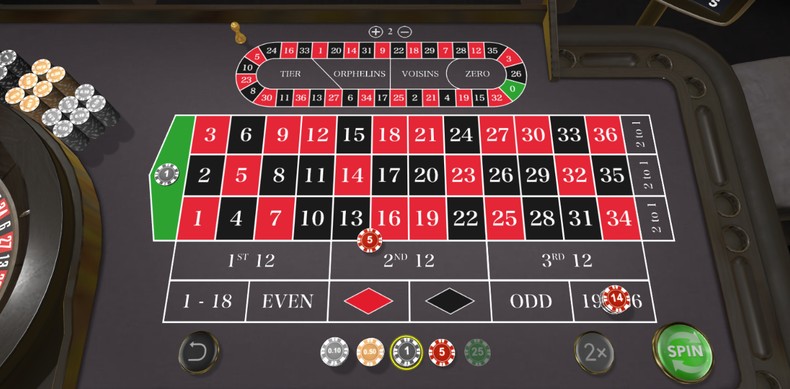
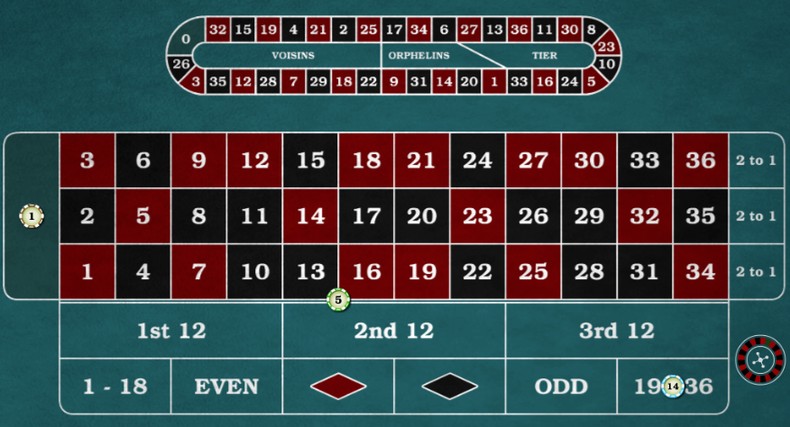
The UK’s favourite fictional spy devised a very specific staking plan for the single-zero version of roulette, which is as follows (for the sake of this article, we are playing with £20 per spin).
- £1 staked on 0
- £5 staked on the line bet 13-18
- £14 staked on 19-36
So what does this mean for players? Well, if the ball lands on any number between one and 12, our entire £20 stake is lost. But if it lands on any of the other 25 numbers – be it zero or 13-36 – we secure a payout.
The nature of that prize will depend upon which number is spun. The ‘high’ bet of 19-36 pays out at odds of 1:1, so in this case we’d net a profit of £14 based on our stake. Our bet on zero pays at 35:1 (so £35 for the James Bond staking plan), while our line bet covering 13-18 earns 5:1 (so £25 here).
Now we can work out the math by deducting lost stakes from our winnings:
| Outcome | Payout | Loss | Net |
|---|---|---|---|
| 0 | £35 | £19 | £16 |
| 13 to 18 | £25 | £15 | £10 |
| 19 to 36 | £14 | £6 | £8 |
| 1 to 12 | £0 | £20 | -£20 |
So therein lies the potential – and the liability – of the James Bond roulette strategy. With 25 of the 37 numbers yielding a win, we would expect to win (based on theoretical probability) with 67.5% of all spins. That’s a handy return.
However, our most common return would be the £8 profit from the 19-36 bet, which is just 40% of each losing spin’s loss of £20 – a scenario that, probability theory decrees, would occur on 32.5% of all spins of the wheel.
Our biggest win – hitting the zero outright – has a theoretical probability of happening on just 3% of spins.
Does the James Bond Roulette Strategy Work?
When he’s battling Blofeld, jousting with Jaws or simply trying to save the world, James Bond had a happy knack for overcoming the odds.
But there’s one opponent he is simply unable to beat in the long run: the roulette wheel.
Let’s imagine we played through 100 spins of the roulette wheel deploying 007’s staking plan. We’ll assume that the wheel is completely fair and that the probabilities of each number landing are satisfied.
While not exact figures (some rounding has taken place), here’s how we would expect those 100 spins to play out:
- 0 – spun three times = profit of £48
- 13-18 – spun 16 times = profit of £160
- 19-36 – spun 48 times = profit of £384
- 1 -12 – spun 33 times = loss of £660
At the end of our 100 spins, we tally up our profit and loss and find we are down £68.
So, for every 100 spins played to a £20 stake, we would expect to lose £68.
For a secret agent like James Bond, who we assume to be on a handsome salary, such losses may be small fry. But for the average Joe or Jane, the upshot is that the James Bond roulette strategy is, unfortunately, not one that is likely to yield a positive return – far from it, in fact.
Is There a Roulette Strategy That Actually Works?
 The problem with roulette is that it’s a game that is based solely on chance – unlike blackjack or player vs dealer poker variants, there is simply no way that you can improve your chances of winning.
The only way you can be smart at the wheel is in your staking, but many of the most popular progressive staking plans – such as Martingale, Fibonacci or Labouchere – are flawed. These assume that you won’t go on a lengthy losing streak, or that you have a bottomless pit of money to recoup the losses of a downturn in fortunes.
The reality is that you can and perhaps will embark on losing streaks in roulette, which can decimate your bankroll when using a staking plan like those mentioned.
As for the James Bond roulette system, you are likely to be left shaken not stirred by the losses it can run up….